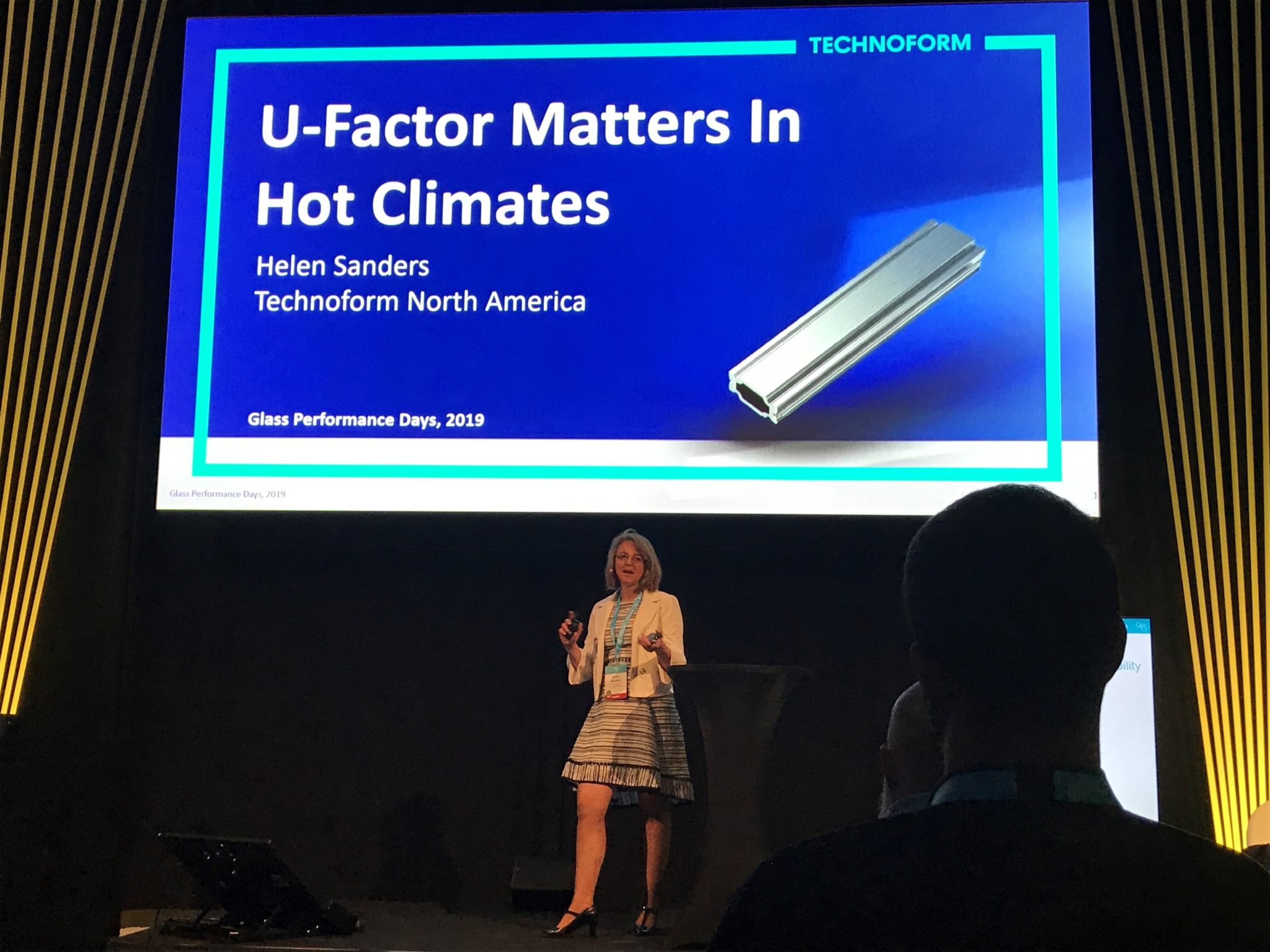
As those of you who have been following the coverage by the glass press may have gathered, Glass Performance Days (GPD) in Finland was the place to be at the end of June. The “Who’s Who” of the global glass industry gathered to discuss trends, new research, developments and technology. Impressive was the large contingent from North America, as was the sizable delegation from Australia and Asia which, when combined with the Europeans, made it a truly global event.
There were many interesting presentations and some key trends, and while I have endeavored to capture some of the standouts here, there are truly too many to do it justice in just one short blog. I encourage you to browse the full papers online once they become available. In the meantime, links to the abstracts are included below.
Curved insulating glass was a prominent topic with excellent presentations from Walter P. Moore and Associates, Elkus Manfredi Architects, Thornton Tomasetti, Eckersley O’Callaghan, Cristacurva, Heintges Consulting Architects & Engineers (featuring the Nike NYC store) and Roschmann Steel & Glass Construction. Vincente Montes-Amoros of CDC also reviewed the critical question of whether bent safety glass manufactured abroad actually meets U.S. Building Code. There appears to be a critical mass of design and construction experience, engineering protocols and capable fabricators, which likely signals a growth in projects featuring curved insulating glass.
Structural glazing applications and the engineering of glass to meet these requirements were also front and center with presentations from the folks in Arup’s London office, Adam Nizich from Walter P. Moore in Washington, D.C., Lisa Rammig from Eckersley O’Callaghan’s San Francisco office, plus interlayer design calculation methods and parameters from the global Kuraray and Eastman teams.
Climate loads exerted on insulating glass unit’s (IGU’s) edge seals were a welcome new topic of discussion. James Griffith of Arup gave a great overview of his work to develop climatic load parameters for the U.S. climate conditions. Climatic loads can have a significant impact on the longevity of an IGU, not just on the aesthetic appearance. Unfortunately, there currently are no formal standards for assessing climate loads and resultant edge seal stresses, although many fabricators have developed rules for managing altitude changes at a minimum. Lack of effective climate load related design standards has been a concern of mine for some years and I will dig into more details in a future blog. More work is definitely needed in this area.
Thermal performance was as prominent as ever, with Olivier Brouard from Skidmore Owings and Merrill (SOM) giving an entertaining and informative presentation on envelope performance optimization. As a reminder of the importance of buildings and their skin, he quoted Edward Mazria, founder of Architecture 2030 and author of “It’s The Architecture, Stupid,” who identifies architecture as “the biggest source of emissions and energy consumption in this country.”
He then reviewed the results of a parametric analysis studying the impact of envelope variables (e.g. window to wall ratio, frame and center of glass performance) on the ability to meet energy code for a large multi-story building in Beijing.
His thermal analysis of the curtainwall system showed the negative impact of the fenestration edge, especially when frames are not effectively thermally broken, and how improving the center of glass U-factor does not improve performance enough without improving the frame too. In his conclusion, Brouard stated that “the frame system is a key design variable driving the overall building envelope performance,” supporting Technoform’s common refrain to “specify the edge.”
Brouard’s presentation dovetailed nicely to mine on why U-factor matters in hot climates. In conversation afterward, Olivier shared with me some data showing that reducing U-factor was more impactful than solar heat gain reduction in improving energy performance, even in large buildings with large internal loads. The reason is the same as why U-factor matters in hot climates – because of large conductive heat gains caused by uncontrolled transmittance of absorbed solar heat through poorly thermally broken curtainwall framing.
I have already marked my calendar for GPD in June 2021. It is sure to be an event not to miss and I hope to see you there.